
Following up on last week’s post, here is a broader look at a researcher who inspires me.
Introduction
Dr. Rua M. Williams is an assistant professor at the school of applied and creative computing at Purdue University, and the principle investigator at the CoLiberation Lab. They specialize in the intersection of technology policy and research practice in areas of critical disability studies, Autism, and human-centred computing.
Data
In order to find relevant materials for Dr. Williams, I conducted author-based searches on the OpenAlex and Scopus bibliometric databases, limiting the results peer-reviewed journal articles and conference papers published between 2013 and 2023. 36 publications were identified by combining the results of the two searches. The publication data included co-authorship, citation, open access, and altmetric data. Additional altmetric data was retrieved using the CrossRef API.
Methods
The raw data for everything except altmetrics were imported in a LibreOffice spreadsheet. Data cleaning and summary generation were accomplished with a variety of formula functions. For example, retrieving the total number of authors of a publication not including Dr. Williams used the formula =LEN(openalex.C2)-LEN(SUBSTITUTE(openalex.C2,”|”,””)) for the OpenAlex author field, which is delimited using | characters.
Additional altmetric data was retrieved from CrossRef using it’s HTTP API. Each unique DOI was passed to the CrossRef API using the curl tool, and the resulting JSON was parsed using the jq tool to eliminate results with no altmetric entries and to reformat the data into CSV format. The command to accomplish that: cat dois.csv| (while read i; do echo “$i”; curl ‘https://api.eventdata.crossref.org/v1/events?mailto=ss523277@dal.ca&obj-id='”$i”‘&rows=1000’ >>crossref.json; sleep 1; done) | jq -r ‘select(.message.events | length > 0).message.events[] | [.occurred_at,.subj_id, .relation_type_id, .obj_id, .source_id] | @csv’ >crossref.csv. From there, LibreOffice analysis proceeded in the same way as for the publication data.
Results
The results are grouped into five areas: research output, research impact, altmetrics, collaboration, and open access.
Research output
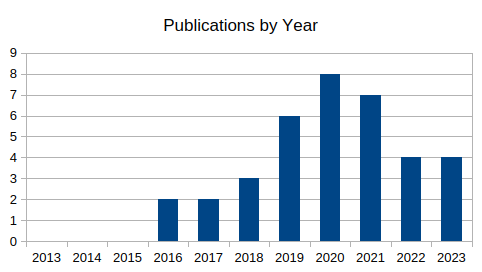
While Dr. Williams has given interviews and conference talks, written blog posts and book chapters, produced podcast episodes, and disseminated their research outputs through a variety of channels to a variety of audiences, the focus of this analysis is on the scholarly communication conducted through peer-reviewed journal articles and conference papers. Dr. Williams began publishing this type of material in 2016, and was most prolific during their collaborative work in 2020.
| Year | Publication Count |
| 2013 | 0 |
| 2014 | 0 |
| 2015 | 0 |
| 2016 | 2 |
| 2017 | 2 |
| 2018 | 3 |
| 2019 | 6 |
| 2020 | 8 |
| 2021 | 7 |
| 2022 | 4 |
| 2023 | 4 |
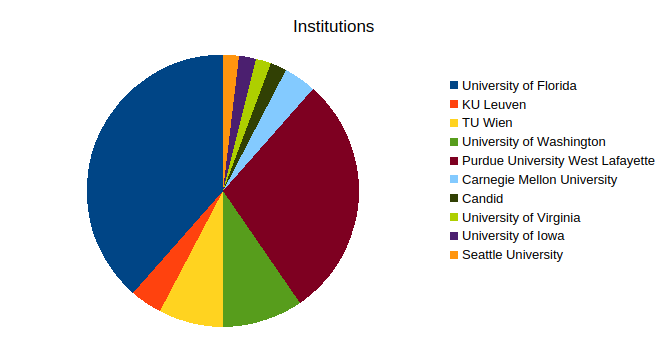
The primary institution associated with their work also shows wide variety, with the University of Florida and Purdue University West Lafayette being the most common. While Dr. Williams teaches at Purdue University West Lafayette , they often collaborate across institutions, as shown below.
16 of the 36 publications were solo efforts. Of those, four with Purdue University West Lafayette, and six were associated with the University of Florida where they were a graduate fellow. They changed institutions in 2020, and have sustained a higher publication count per year since then.
| Institution | Count |
| University of Florida | 20 |
| Purdue University West Lafayette | 15 |
| University of Washington | 5 |
| TU Wien | 4 |
| KU Leuven | 2 |
| Carnegie Mellon University | 2 |
| Candid | 1 |
| University of Virginia | 1 |
| University of Iowa | 1 |
| Seattle University | 1 |
Research impact
While measuring impact is a complicated endeavour, using indicators such as citation counts can give an indication of how much impact a researcher is making within their field.
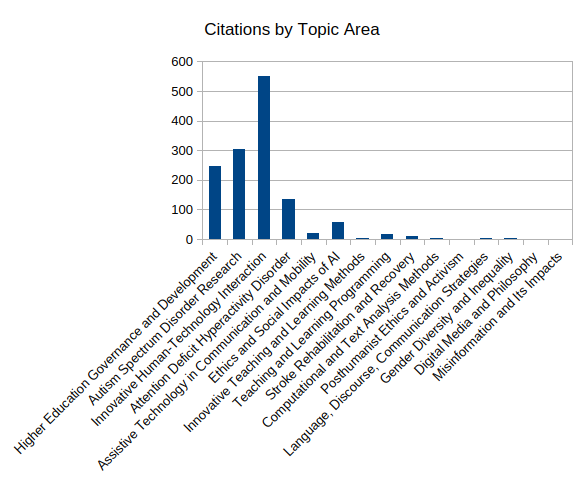
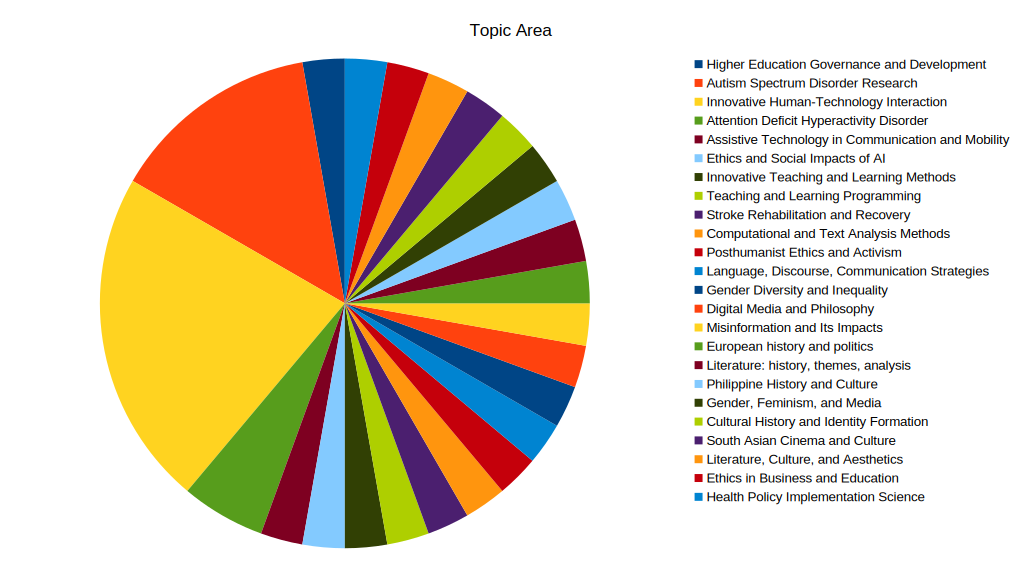
Dr. Williams work intersects with a wide variety of disciplines. It can often be difficult to categorize disciplines and the works within them in a logical and consistent manner. This portion of the analysis utilizes the topic data provided by OpenAlex, but the method that database assigns topics to works is not always transparent or consistent. For example, the paper “Tackling the Lack of a Practical Guide in Disability-Centered Research” touches on research methodology, critical disability theory, Autism Spectrum Disorder and Attention Deficit Hyperactivity Disorder, but was assigned the topic “Assistive Technology in Communication and Mobility.” These topic identifiers should be a general indication of the areas that Dr. Williams engages with, and the publication count in each topic should be seen as a general indication rather than a concrete classification.
| Topic | Count |
| Higher Education Governance and Development | 1 |
| Autism Spectrum Disorder Research | 5 |
| Innovative Human-Technology Interaction | 8 |
| Attention Deficit Hyperactivity Disorder | 2 |
| Assistive Technology in Communication and Mobility | 1 |
| Ethics and Social Impacts of AI | 1 |
| Innovative Teaching and Learning Methods | 1 |
| Teaching and Learning Programming | 1 |
| Stroke Rehabilitation and Recovery | 1 |
| Computational and Text Analysis Methods | 1 |
| Posthumanist Ethics and Activism | 1 |
| Language, Discourse, Communication Strategies | 1 |
| Gender Diversity and Inequality | 1 |
| Digital Media and Philosophy | 1 |
| Misinformation and Its Impacts | 1 |
| European history and politics | 1 |
| Literature: history, themes, analysis | 1 |
| Philippine History and Culture | 1 |
| Gender, Feminism, and Media | 1 |
| Cultural History and Identity Formation | 1 |
| South Asian Cinema and Culture | 1 |
| Literature, Culture, and Aesthetics | 1 |
| Ethics in Business and Education | 1 |
| Health Policy Implementation Science | 1 |
Altmetrics
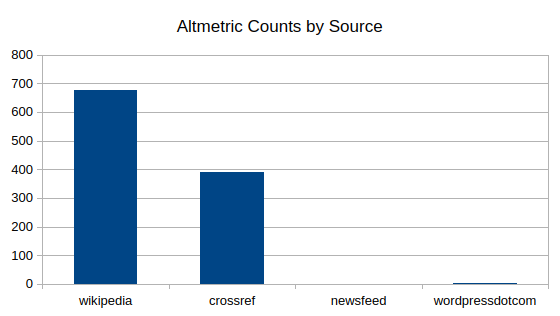
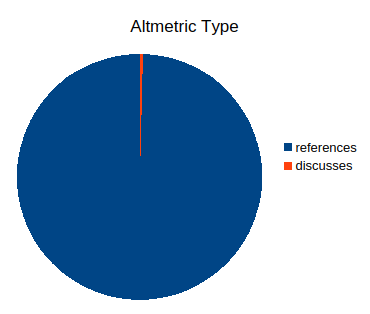
Altmetrics are intended to gauge research impact by assessing the frequency with which the research is mentioned outside of scholarly citation. Much of Dr. Williams’ work focuses on very narrow research topics that aren’t always accessible to the general public. As a result, there is very little direct mention of their work in mainstream and social media. Most of the altmetric mentions identified by CrossRef were in edits made to the researchers’ Wikipedia pages. The second most frequent source was the scholarly citation category, which was already considered above in the research impact section. Excluding those, there were only five altmetric mentions identified by CrossRef: four blog posts hosted by wordpress.com, and one mention in a mainstream news article. These five references constitute the “discusses” altmetric type.
Collaboration
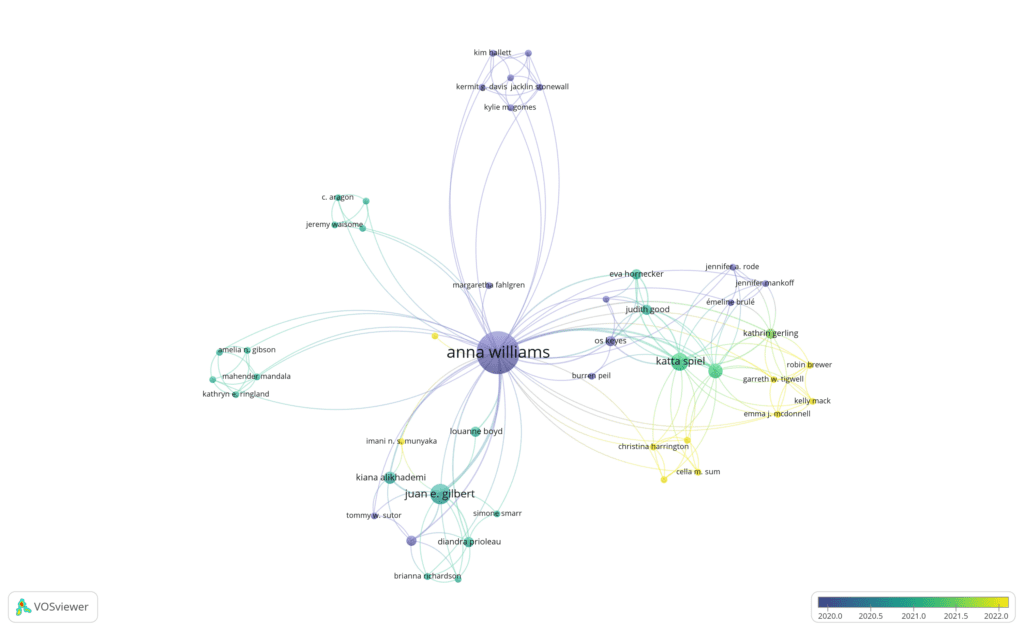
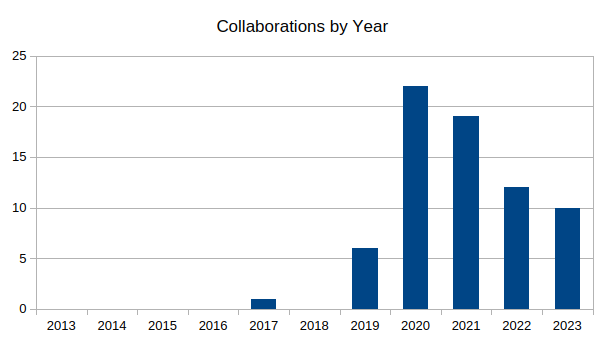
We next examine the authors with which Dr. Williams has published. The publication collaborations are visualized by VOSviewer below. The graph shows five distinct clusters of collaboration across the twenty works published with other researchers. The colours of the graph’s edges show that some of these collaboration efforts are transitory, while others span the entire analyzed period. Two nodes were notably larger than the others (Gilbert and Spiel), indicating many works were authored with each, but the lack of connection between them indicates those three did not collaborate together but separately. It also indicates that Dr. Williams’ collaborators often also collaborate with each other, sometimes working as a group on multiple publications together. There were also five works with only one other author, resulting in several nodes that were only connected to Dr. Williams and no one else.
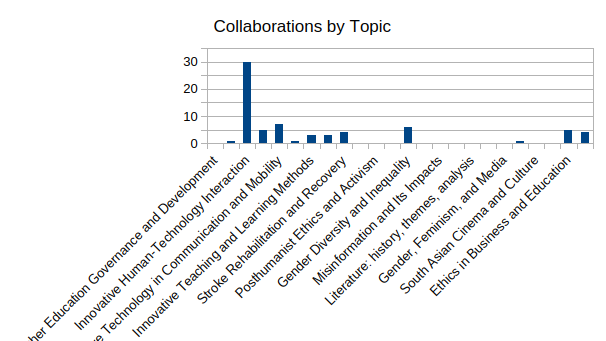
With the same caveats noted above about the classification of publications by topic, we can see that most of Dr. Williams’ collaborative efforts have focused in the Innovative Human-Technology Interaction area, with a total of 30 non-distinct collaborators on papers in that area.
Mirroring the publication count graph from the research output section, we can see that Dr. Williams significantly increased their collaborative publishing after transitioning to Purdue University West Lafayette in 2020.
Open access
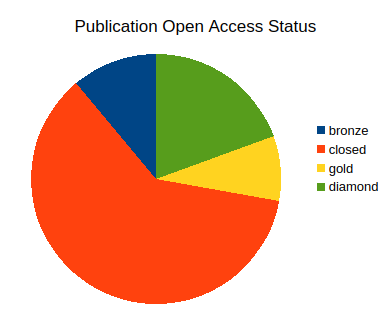
Most of the papers published by Dr. Williams were not in open access journals. Of the 36 examined publications, 22 were closed, 4 were bronze, 3 were gold, and 7 were diamond.
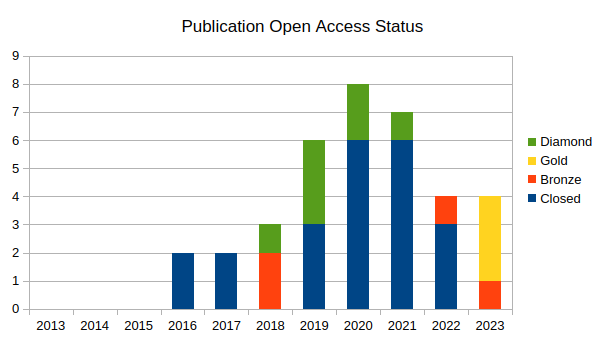
Most of their diamond publications were centred around their relocation year of 2020, and 2023 saw the first publications in gold open access journals.
| Year | Closed | Bronze | Gold | Diamond |
| 2013 | 0 | 0 | 0 | 0 |
| 2014 | 0 | 0 | 0 | 0 |
| 2015 | 0 | 0 | 0 | 0 |
| 2016 | 2 | 0 | 0 | 0 |
| 2017 | 2 | 0 | 0 | 0 |
| 2018 | 0 | 2 | 0 | 1 |
| 2019 | 3 | 0 | 0 | 3 |
| 2020 | 6 | 0 | 0 | 2 |
| 2021 | 6 | 0 | 0 | 1 |
| 2022 | 3 | 1 | 0 | 0 |
| 2023 | 0 | 1 | 3 | 0 |
Discussion
Dr. Williams has been an inspiration to me since I first encountered their research in 2019, and it was interesting to see this analytical view into the research career of someone I look up to. One of the challenges with bibliometric research is author identification, and Dr. Williams presents two challenges in this regard: the name Anna Williams is shared by many other researchers, and they have changed their name twice during their research career. The result is that some bibliographic records were likely missed based on author name search, and some records may have been included despite being authored by a different researcher with a similar name. While Scopus and OpenAlex both offer unique author identifier fields, there were still instances of obviously incorrect attribution of publications to this Dr. Williams. I endeavoured to remove incorrect publications in this case, but the reverse case of missing publications is more difficult to ascertain.
As noted above, the division of research as an endeavour into disciplines, fields, and topics presents a taxonomic challenge. The lack of agreement on the taxonomy itself is dwarfed by the challenge of consistently applying it to the classification of research outputs. OpenAlex only provides a primary topic in their data export, and while having additional topics associated with the publications would increase flexibility, that comes at the cost of increased complexity for both computation and understanding.
Neither OpenAlex nor Scopus included altmetric data in their exports, despite the latter partnering with Plum Analytics. Manually examining the Plum Analytics data for each publication through the web interface proved too labour intensive to pursue. The Altmetric service may have been easier, but Dalhousie does not have a subscription as far as I could determine, and their free bookmarklet web page was broken when I attempted to access it. Overton was not considered given its focus on policy documents, and Dr. Williams does not appear to have an ImpactStory profile. Using the CrossRef API was an interesting software challenge, but would likely exceed the capacities of most bibliometric students pursuing this sort of analysis.
And of course, Dr. Williams has many publications and other research outputs that don’t fall within the confines of scholarly communication, so this analysis is necessarily limited and likely misses a significant portion of their impact. Nevertheless, as a snapshot of a researcher’s scholarly communications, I believe this project is a success, and I’ve gained a much stronger understanding of bibliographic analysis as a result.
References
Gomes, K., Nguyen, T., Stonewall, J., Davis, K., Coppola, S., Hallett, K., & Williams, A. (2020). Inclusion and Accessibility in The Human Factors and Ergonomics Society. Proceedings of the Human Factors and Ergonomics Society Annual Meeting, 64(1), 559–562. https://doi.org/10.1177/1071181320641127
Keyes, O., Peil, B., Williams, A., & Spiel, K. (2020). Reimagining (Women’s) Health. ACM Transactions on Computer-Human Interaction, 27(4), 1–42. https://doi.org/10.1145/3404218
Ladner, R., Aragon, C., Robinson, J., Waisome, J., & Williams, A. (2021). Panel: An intersectional approach to including disability in BPC. 55, 1–2. https://doi.org/10.1109/respect51740.2021.9620723
McDonnell, E., Mack, K., Gerling, K., Spiel, K., Bennett, C., Brewer, R., Williams, A., & Tigwell, G. (2023). Tackling the Lack of a Practical Guide in Disability-Centered Research. 1–5. https://doi.org/10.1145/3597638.3615650
Prioleau, D., Richardson, B., Drobina, E., Williams, A., Martin, J., & Gilbert, J. (2021). How Students in Computing-Related Majors Distinguish Social Implications of Technology. 1013–1019. https://doi.org/10.1145/3408877.3432360
Spiel, K., Gerling, K., Bennett, C., Brulé, É., Williams, A., Rode, J., & Mankoff, J. (2020). Nothing About Us Without Us. 1–8. https://doi.org/10.1145/3334480.3375150
Spiel, K., Hornecker, E., Williams, A., & Good, J. (2022). ADHD and Technology Research – Investigated by Neurodivergent Readers. CHI Conference on Human Factors in Computing Systems, 1–21. https://doi.org/10.1145/3491102.3517592
Sum, C., Alharbi, R., Spektor, F., Bennett, C., Harrington, C., Spiel, K., & Williams, A. (2022). Dreaming Disability Justice in HCI. CHI Conference on Human Factors in Computing Systems Extended Abstracts, 1–5. https://doi.org/10.1145/3491101.3503731
Williams, A. (2016a). Contested Freedom: Agnes von Krusenstjerna’s Novel the Misses von Pahlen and the Film Adaptation Loving Couples. 433–442.
Williams, A. (2016b). Women Writers and Literary Canon Formation. 17(1).
Williams, A. (2017). “The Dramatic Poet and the Unpoetic Multitudes”: Elizabeth Barrett Browning’s Allegorized Theatrical Commentary in Book IV of Aurora Leigh. Victorian Poetry, 55(3), 309–329. https://doi.org/10.1353/vp.2017.0017
Williams, A. (2018a). Academic ableism: Disability and higher education. Disability & Society, 33(4), 651–653. https://doi.org/10.1080/09687599.2018.1438052
Williams, A. (2018b). Authoring autism: On rhetoric and neurological queerness. Disability & Society, 33(6), 996–997. https://doi.org/10.1080/09687599.2018.1457500
Williams, A. (2018c). Autonomously Autistic. Canadian Journal of Disability Studies, 7(2), 60–82. https://doi.org/10.15353/cjds.v7i2.423
Williams, A. (2019a). Metaeugenics and Metaresistance: From Manufacturing the ‘Includeable Body’ to Walking Away from the Broom Closet. Canadian Journal of Children s Rights / Revue Canadienne Des Droits Des Enfants, 6(1), 60–77. https://doi.org/10.22215/cjcr.v6i1.1976
Williams, A. (2019b). Review of David James Savarese (Producer) & Robert Rooy (Director, Producer), Deej (2017). Canadian Journal of Disability Studies, 8(3), 165–168. https://doi.org/10.15353/cjds.v8i3.513
Williams, A. (2019c). Review of Unspoken (2017). Canadian Journal of Disability Studies, 8(5), 161–162. https://doi.org/10.15353/cjds.v8i5.571
Williams, A. (2020a). Falsified Incompetence and Other Lies the Positivists Told Me. Canadian Journal of Disability Studies, 9(5), 214–244. https://doi.org/10.15353/cjds.v9i5.696
Williams, A. (2020b). Grad School Gothic:The Mysteries of Udolphoand the Academic #MeToo Movement. Gothic Studies, 22(2), 115–130. https://doi.org/10.3366/gothic.2020.0044
Williams, A. (2020c). Review of Autistic Disturbances: Theorizing Autism Poetics from the DSM to Robinson Crusoe, Julia Miele Rodas (2018). Canadian Journal of Disability Studies, 9(5), 550–553. https://doi.org/10.15353/cjds.v9i5.708
Williams, A. (2021a). I, Misfit. Techné Research in Philosophy and Technology, 25(3), 451–478. https://doi.org/10.5840/techne20211019147
Williams, A. (2021b). Six Ways of Looking at Fractal Mechanics. Catalyst Feminism Theory Technoscience, 7(2). https://doi.org/10.28968/cftt.v7i2.33181
Williams, A. (2022). “Only the Old and Sick Will Die”—Reproducing ‘Eugenic Visuality’ in COVID-19 Data Visualization. 1–5. https://doi.org/10.1109/istas55053.2022.10227111
Williams, A. (2023). Experiments of the mind: From the cognitive psychology lab to the world of Facebook and Twitter By EmilyMartin. Princeton, NJ: Princeton University Press, 2021. 312 pp. American Ethnologist, 50(1), 153–154. https://doi.org/10.1111/amet.13135
Williams, A., Alikhademi, K., Drobina, E., Gilbert, J., & Sutor, T. (2019). Augmented Reality for Rehabilitative Therapy: Patient experiences and Practitioner perspectives. Proceedings of the Human Factors and Ergonomics Society Annual Meeting, 63(1), 748–752. https://doi.org/10.1177/1071181319631140
Williams, A., Alikhademi, K., & Gilbert, J. (2021). Design of a toolkit for real-time executive function assessment in custom-made virtual experiences and interventions. International Journal of Human-Computer Studies, 158, 102734–102734. https://doi.org/10.1016/j.ijhcs.2021.102734
Williams, A., Alikhademi, K., Munyaka, I., & Gilbert, J. (2022). MetaCogs: Mitigating Executive Dysfunction via Agent-based Modeling for Metacognitive Strategy Development. ACM Transactions on Accessible Computing, 15(3), 1–32. https://doi.org/10.1145/3514254
Williams, A., & Boyd, L. (2019). Prefigurative Politics and Passionate Witnessing. 262–266. https://doi.org/10.1145/3308561.3355617
Williams, A., Boyd, L., & Gilbert, J. (2023). Counterventions: A reparative reflection on interventionist HCI. 1–11. https://doi.org/10.1145/3544548.3581480
Williams, A., & Fahlgren, M. (2017). Work and Women Abroad: Aspects of the Reception of Translated Swedish Working-Class and Feminist Literature. 169–189.
Williams, A., & Gilbert, J. (2019). Cyborg Perspectives on Computing Research Reform. 1–11. https://doi.org/10.1145/3290607.3310421
Williams, A., & Gilbert, J. (2020). Perseverations of the academy: A survey of wearable technologies applied to autism intervention. International Journal of Human-Computer Studies, 143, 102485–102485. https://doi.org/10.1016/j.ijhcs.2020.102485
Williams, A., & Park, C. (2023). Cyborg Assemblages: How autistic adults construct sociotechnical networks to support cognitive function. 1–15. https://doi.org/10.1145/3544548.3581556
Williams, A., Ringland, K., Gibson, A., Mandala, M., Maibaum, A., & Guerreiro, T. (2021). Articulations toward a crip HCI. Interactions, 28(3), 28–37. https://doi.org/10.1145/3458453
Williams, A., Smarr, S., Prioleau, D., & Gilbert, J. (2021). Oh No, Not Another Trolley! On the Need for a Co-Liberative Consciousness in CS Pedagogy. IEEE Transactions on Technology and Society, 3(1), 67–74. https://doi.org/10.1109/tts.2021.3084913
Ymous, A., Spiel, K., Keyes, O., Williams, A., Good, J., Hornecker, E., & Bennett, C. (2020). “I am just terrified of my future” Epistemic Violence in Disability Related Technology Research. 1–16. https://doi.org/10.1145/3334480.3381828